ChatGPT Ads is OpenAI’s advertising program, a set of clearly labelled sponsored placements that appear below ChatGPT’s answers and are matched to the conversation a user is already having. That single difference, matching to conversation instead of keywords, changes how you plan, buy, and measure the channel.
If you are asking what is ChatGPT Ads because you saw one in your own chat window, the short version is this: OpenAI started the pilot in the United States in February 2026, extended it to Canadian Free and Go tier users on April 16, and opened self-serve buying in May. ChatGPT Ads 2026 is no longer a closed test for holding companies. Any eligible business can register and run a campaign.
Canadian advertisers have a specific reason to pay attention right now, and it has nothing to do with hype. The exposure is already here. The competition is not.
Key numbers
- ChatGPT reached 900 million weekly active users globally, per OpenAI.
- OpenAI began testing ads in ChatGPT in the United States in February 2026, then expanded to Canada, Australia, and New Zealand.
- Ads went live for Canadian Free and Go tier users on April 16, 2026.
- OpenAI launched its beta self-serve Ads Manager on May 5, 2026, adding CPC bidding and pixel plus Conversions API measurement (OpenAI).
- OpenAI added product feed campaigns for retailers in June 2026, supporting up to 1 million SKUs per advertiser.
- Pilot advertisers bid between $3 and $5 per click, while CPM fell from an opening rate of $60 to roughly $25 in some deals (Quartz).
- The minimum campaign commitment dropped from $250,000 to $50,000, and then to nothing.
- Reuters reported OpenAI booked over $100 million from the US ad pilot in its first six weeks.
- OpenAI targets $2.5 billion in ad revenue for 2026 and $100 billion by 2030 (Axios).
What is ChatGPT Ads, and where do the ads actually appear?
ChatGPT Ads are single sponsored units that render below ChatGPT’s answer, marked as sponsored and visually separated from the response. The format is deliberately plain: a favicon and text, with product imagery where a retailer has connected a catalogue feed. There is no video, no rich media, and no animated creative. OpenAI’s stated position is that the user experience comes first.
Placement is restricted by tier. Ads show only to people on the Free and Go plans. Plus, Pro, Team, Enterprise, and Edu subscribers see nothing, because those tiers are contractually ad-free. OpenAI also withholds ads from accounts it predicts belong to users under 18.
Certain topics stay off limits entirely. Ads are not eligible to appear near health, mental health, or political content, and OpenAI excludes advertisers in dating, alcohol, tobacco, gambling, financial services, and legal categories.
The answer itself stays independent. OpenAI has been explicit that advertising does not influence what the model says, and advertisers never receive access to individual conversations or personal details. What they get back is aggregated performance data.
How is ChatGPT Ads different from Google Ads?
Google matches your ad to a keyword the user typed. ChatGPT matches your ad to the problem the user is working through across an entire conversation, including comparisons they have already made and how close they are to deciding. The signal is richer. It is also harder to control, which is why the buying model looks different.
| Google Ads | ChatGPT Ads | |
|---|---|---|
| Targeting input | Keywords, audiences, demographics | Context hints describing the conversations you want to appear beside, or a connected product feed for retail catalogues |
| Intent captured | A single query | A full decision conversation |
| Creative formats | Text, image, video, Shopping, Performance Max | Favicon plus text, one unit per answer. Retail feeds generate product units automatically |
| Bidding | CPC, CPM, tCPA, tROAS, Max Conversions | CPC and CPM |
| Measurement | GA4, Google tag, offline import, third party | Pixel, Conversions API, UTMs. Third party not yet live |
| Auction maturity | Saturated after two decades | Thin, still in beta |
| Advertiser eligibility | Nearly global | US, Canada, Australia, New Zealand |
The practical consequence for your media plan: ChatGPT Ads does not replace paid search campaigns. It reaches people earlier, while they are still defining the problem, before they know which query to type or which vendor to shortlist.
That earlier position is valuable and harder to attribute. Plan for it accordingly.
What is ChatGPT Ads Manager and how do you buy a campaign?
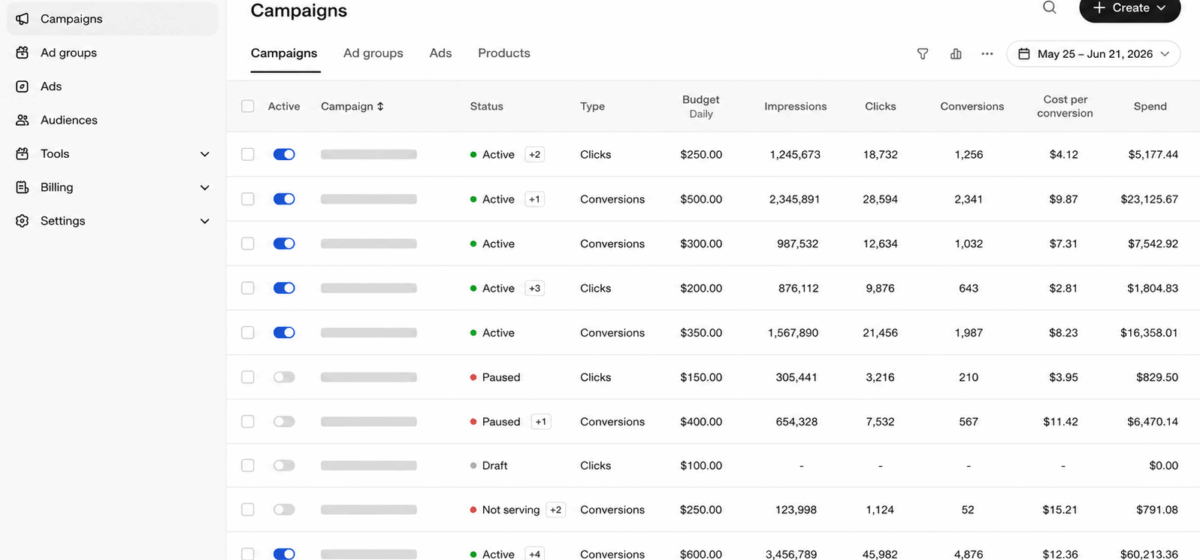
ChatGPT Ads Manager is OpenAI’s self-serve advertising platform at ads.openai.com, launched in beta on May 5, 2026. Setting up an account, defining budgets and creative, and monitoring performance in the portal is exactly the kind of operational work we handle for our clients at Deeploy — there is no minimum spend and no invitation required to get started.
Campaigns follow a three-level hierarchy: campaign, ad group, ad. Every campaign goes through review before it serves.
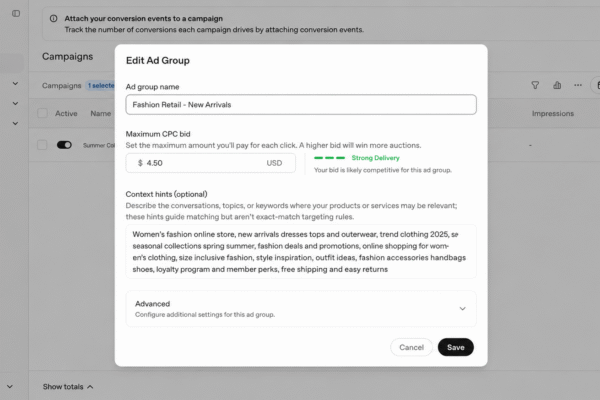
The targeting step is where most advertisers stumble. Instead of selecting audience segments, you write context hints that describe the kinds of conversations your ad should sit beside. A real estate brokerage does not target “homeowners aged 35 to 54 in Toronto.” It describes someone asking whether they can afford to upgrade before their kids change schools. Getting this right takes iteration — it’s one of the areas where having a team that already knows the platform makes the biggest difference. If you want the mechanics, we walk through the whole build in our guide on how to advertise on ChatGPT.
Retailers get a second route: product feeds
Context hints are not the only way in. In June 2026 OpenAI added a Feeds section to Ads Manager, letting retailers connect a structured product catalogue and have ads generated automatically from product names, images, and attributes rather than built one at a time. The platform supports up to one million SKUs per advertiser, and new ecommerce partners submit a 100-product sample before connecting a full catalogue.
OpenAI has said feed-based ads are among the strongest-performing formats in the beta so far. The feature arrived after instant checkout was retired in March 2026, which moved the retail opportunity from selling inside the chat to driving qualified traffic out of it.
The practical read: if you run ecommerce with a real catalogue, feeds are the faster path to volume. If you sell a service, context hints are the only route, and the writing carries the whole campaign.
Buying can also go through agency and technology partners — Criteo, StackAdapt, Kargo, Adobe, and Pacvue were named at the May 2026 self-serve launch — with OpenAI’s own system controlling delivery decisions in every case.
Measurement runs on a pixel and a Conversions API, which report aggregated outcomes such as purchases, leads, and sign-ups. Independent third-party verification is not live yet, so we treat the platform’s own reporting as the primary source and reconcile it against your CRM.
Why ChatGPT Ads 2026 is a narrower window than it looks for Canadian advertisers
Canadian ad exposure has already passed the United States. Independent tracking reported in July 2026 put ChatGPT ad penetration for the trailing seven days ending July 3 at 53.6% in Canada against 51.0% in the US, measured across Free and Go tier traffic. Canadian users are seeing sponsored results at a higher rate than the market OpenAI piloted in first.
Advertiser participation has not caught up. Most Canadian businesses still treat the channel as a US experiment, which leaves the auction thin at exactly the moment exposure peaks. That gap is the entire opportunity, and gaps like this close.
The economics show the direction of travel. CPM opened at $60 and settled near $25. Entry cost went from a $250,000 commitment to zero. Every one of those moves brings more advertisers in, and every new advertiser bids the auction up. The advertisers testing now are buying data and creative learning at prices that will not repeat.
Those are industry figures. Our own numbers from running the format in live US and Canadian accounts are published in full, including the click-through rate nobody else wants to talk about: what we learned testing ChatGPT Ads.
Treat the window as a reason to test deliberately, not a reason to move budget wholesale. A structured test with real conversion tracking beats a large uncontrolled spend on a beta platform every time.
Who should test ChatGPT Ads now, and who should wait
Test now if your buyers research before they commit. B2B SaaS, professional services, education, real estate, and considered ecommerce all fit, because their customers ask open-ended questions for weeks before they contact anyone. Those questions are happening inside ChatGPT already.
Retail is a stronger case than it was six months ago. If you have a catalogue worth connecting, product feeds remove the hardest part of the setup and let the platform generate units from inventory you already maintain, which is why OpenAI reports them as a top-performing format.
Wait if you sell impulse purchases, if you depend on same-day local intent, or if your category sits on OpenAI’s exclusion list. A restaurant chasing dinner reservations tonight is better served elsewhere.
Two prerequisites apply regardless of fit. You need a landing page built to receive conversational traffic, and you need conversion tracking that survives the handoff. Without both, you will spend money you cannot evaluate.
There is also an organic side to this surface. Paid placement puts you below the answer, while Generative Engine Optimization (GEO) works on being named inside it. Running both is what makes the channel compound.
Deeploy is a Digital Marketing Agency Toronto businesses hire to run exactly this kind of test: a certified Google Premier Partner in the top 3% globally, managing more than $10 million in annual ad spend across 35 countries. Our ChatGPT Ads work covers Ads Manager setup, context hint strategy, pixel and Conversions API implementation, and blended reporting next to your Google, Meta, and Microsoft campaigns, so you compare true ROAS instead of guessing.
If you want a read on whether your category is worth testing before the auction tightens, book a strategy call and we will tell you honestly, including when the answer is no.
Frequently asked questions about ChatGPT Ads
Can Canadian businesses advertise on ChatGPT right now?
Yes. As of mid 2026, OpenAI lists advertiser eligibility for businesses based in the United States, Canada, Australia, and New Zealand. Eligibility is determined by the business location and category you enter when creating your ads.openai.com account. Excluded categories are rejected at that step.
How much does it cost to start with ChatGPT Ads?
There is no minimum spend on the self-serve Ads Manager. Pricing runs on an auction, so what you pay per click or per thousand impressions moves with demand and competition rather than sitting at a fixed rate. Budget for a test large enough to reach statistical confidence rather than a token amount that teaches you nothing.
Will running ads change how ChatGPT answers questions about my brand?
No. OpenAI states that ads do not influence the model’s organic responses, and that answers stay independent of advertising. Paid placement earns you a labelled unit below the answer. Being cited inside the answer itself is an organic outcome that depends on your content and authority.
Do ChatGPT Ads work for local service businesses?
Rarely, at this stage. The platform captures research conversations rather than immediate local intent, and it has no radius targeting comparable to Google’s. Local businesses with long consideration cycles, such as renovation contractors or clinics outside restricted categories, are the exception worth testing.
How do I track conversions from a ChatGPT ad?
Install OpenAI’s measurement pixel and connect the Conversions API, then tag every destination URL with UTMs so the traffic is identifiable in GA4. Reconcile platform-reported conversions against your CRM monthly. Third-party measurement verification is not available yet, which makes that reconciliation the control.
ChatGPT Ads 2026 rewards the advertisers who test before the auction fills
The channel is early, the format is limited, and the measurement is incomplete. All three are true, and none of them are reasons to sit out. Canadian users are seeing more ChatGPT ads than American users, the auction is still thin, and entry costs nothing beyond the media you choose to spend.
The advertisers who learn how context hints behave, which offers earn clicks in a chat window, and what a qualified lead from this surface actually looks like will hold that advantage when the rest of the market arrives. That learning is not purchasable later at the same price.
Start with one controlled test, real tracking, and a clear read on whether your buyers are researching in ChatGPT. If they are, the window is open now.