
Most of what has been written about ChatGPT Ads comes from press releases and platform documentation. This post is different: these are the numbers we recorded running the format in live United States and Canada accounts, including the metric the rest of the industry keeps quiet about.
The short version: cost per click is competitive, click-through rate is not, and the format’s position at the end of the answer explains both. Here is the detail.
What we measured
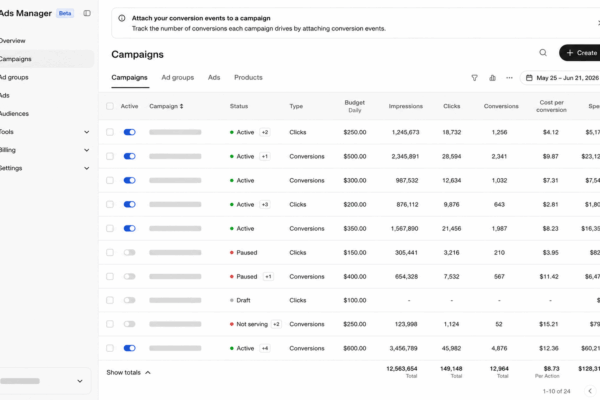
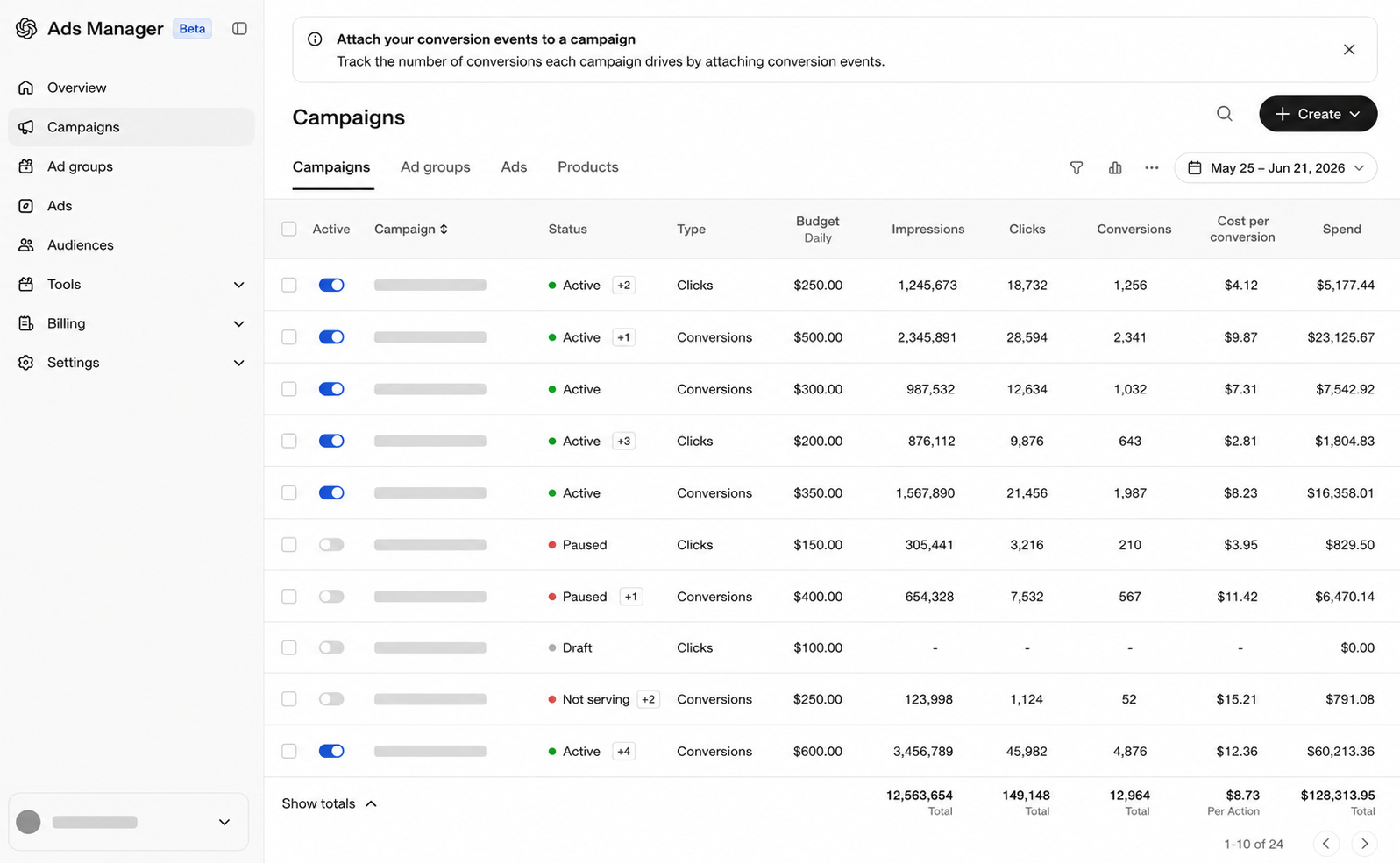
We tested the format in real US and Canadian accounts. These are the ranges we observed:
- Cost per click (CPC): between $2 and $5 USD, in line with competitive search channels.
- Click-through rate (CTR): below 1%. The format still underperforms traditional search on clicks.
- Minimum practical spend: a floor of roughly $25 USD per day for a campaign to accumulate enough data to read.
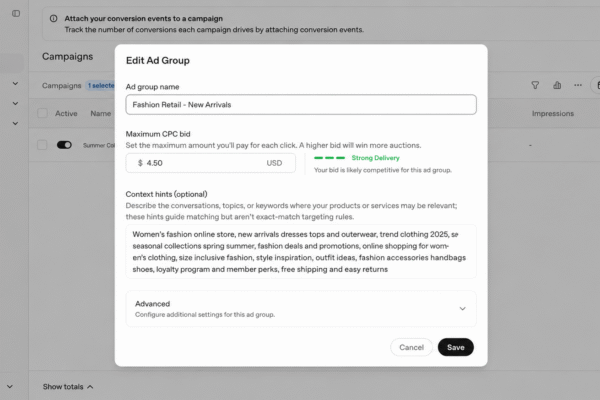
Worth noting how our CPC compares to the platform’s own guidance. OpenAI recommends opening CPC bids at $3 to $5 per click. We have cleared impressions below that range, which is what you would expect from a relevance-weighted auction rewarding tightly matched creative over raw bid.
Why the click-through rate is low, and whether that matters
The takeaway is nuanced. On one hand, intent-based matching is genuinely promising: you appear in front of someone who is literally asking about what you offer, inside a high-trust environment, at a point in their thinking that search rarely catches.
On the other hand, the placement itself limits visibility. The ad sits at the end of the answer, and in a large share of conversations the user already got what they needed before scrolling that far. In our experience that single structural fact, not creative quality, is the main driver behind the sub-1% CTR.
What that means for planning: judge this channel on cost per qualified outcome, not on CTR. A low click rate against a highly qualified impression base is a different problem from a low click rate against a broad one, and treating them the same will make you turn off a channel that was working.
Product feeds changed the retail case
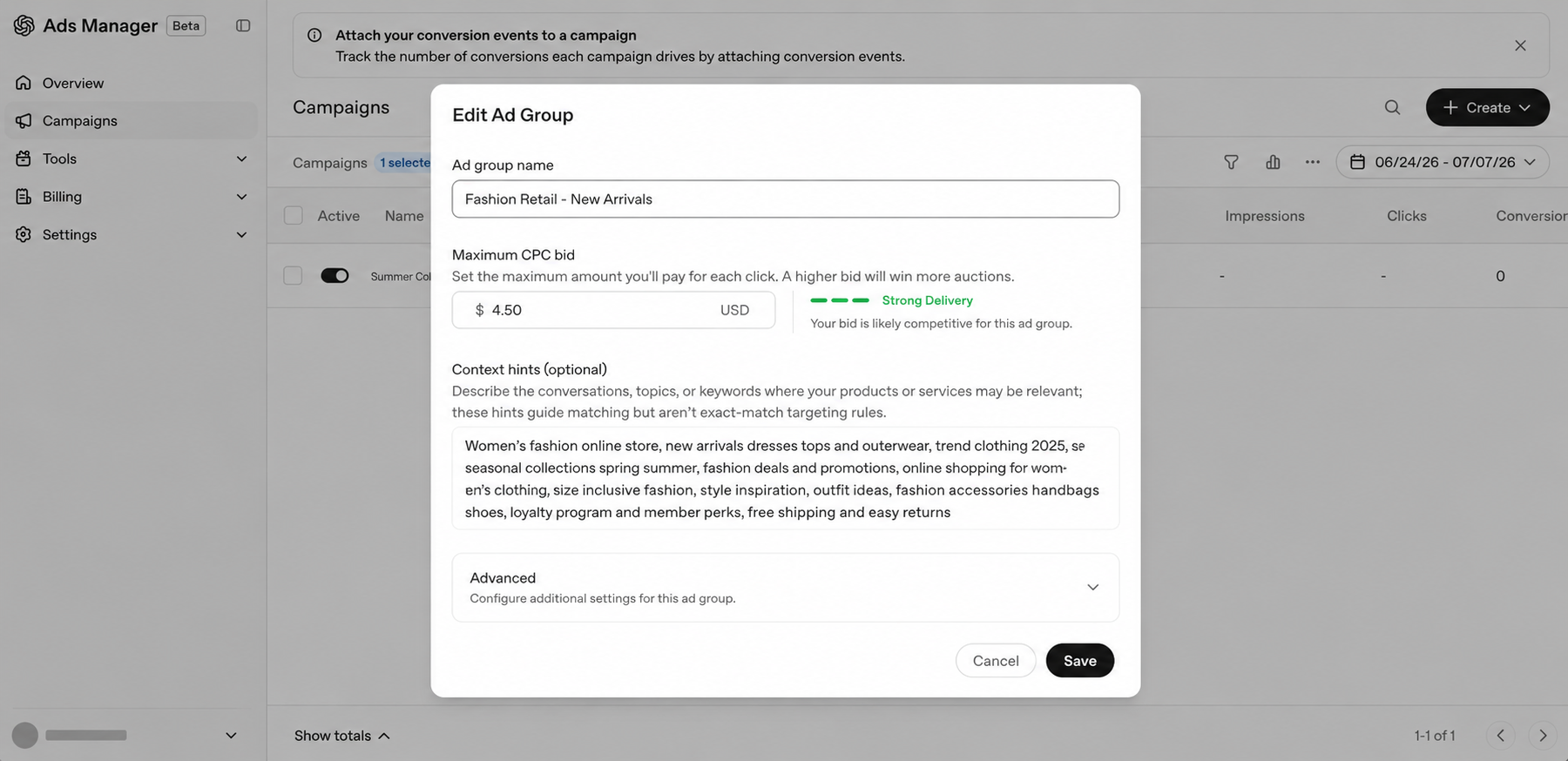
When we first tested, context hints were the only way to tell the platform where you belonged. That is no longer true for retailers.
In June 2026 OpenAI added a Feeds section to Ads Manager. You connect a structured product catalogue and the platform generates ads automatically from each product’s name, images, and attributes, rather than requiring one ad per SKU. It supports up to one million SKUs per advertiser, and new ecommerce partners submit a 100-product sample before connecting a full catalogue. OpenAI has said feed-based ads are among the strongest-performing formats in the beta so far.
The timing is not a coincidence. Instant checkout, which let people complete a purchase inside the chat, was retired in March 2026 — Walmart data showed conversion rates roughly three times lower for in-chat purchases than for users who clicked out to the retailer’s own site. Feeds replaced that model with a more conventional one: use the catalogue to earn the placement, then send the click to a page you control.
If you sell products, this is the single biggest change to the channel since launch. If you sell services, context hints remain your only lever, and the writing carries the campaign.
Who should try ChatGPT Ads today
- Ecommerce and retail with a real catalogue — feeds remove most of the setup burden and are currently the best-performing format on the platform.
- Considered-purchase services willing to learn the logic of context hints before their competitors do.
- Advertisers operating in the United States, Canada, Australia, or New Zealand, which is where advertiser eligibility currently sits.
It remains a channel to enter early and learn rather than one to migrate large budgets into. Don’t expect it to displace your Google Ads campaigns or Meta this year. Do expect the advertiser who masters feed structure and context hints now to be well positioned when OpenAI opens more surfaces.
The same logic applies on the organic side: Generative Engine Optimization (GEO) is about being named inside the answer rather than advertised below it, and visibility inside AI platforms is becoming a channel of its own.
Where to go next
This post is the data. If you want the surrounding context or the mechanics, we have both:
- ChatGPT Ads 2026: what it is and how the channel works — how the channel is structured, how it differs from Google Ads, and who should be testing it.
- How to advertise on ChatGPT: a step-by-step setup guide — account creation through your first thirty days, including how to write context hints that actually deliver.
At Deeploy we’re already testing and measuring these emerging formats for clients. If you’d like to explore ChatGPT Ads management — or any digital media channel — with a team that has hands-on numbers rather than press-release numbers, book a free consultation.