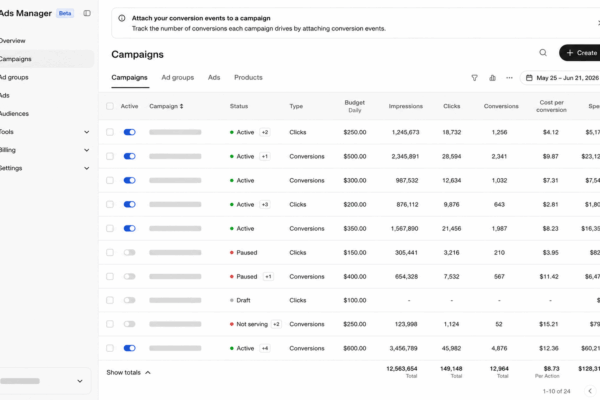
Advertising on ChatGPT means creating a campaign in OpenAI’s Ads Manager Beta, describing the conversations you want to appear beside, and letting a relevance-weighted auction decide whether your ad serves. The bid is not what wins it. The writing is.
This guide covers how to advertise on ChatGPT from account creation to your first thirty days of optimization, including the part most advertisers get wrong: context hints. There is no minimum spend and no invitation, so the barrier to entry is not budget. It is knowing what to type into the four fields that decide whether your campaign delivers.
If you are still deciding whether the channel fits your business at all, start with what ChatGPT Ads is and how the channel works. If you have already made that call, keep reading.
Setup at a glance
- Platform: OpenAI Ads Manager Beta at ads.openai.com, launched May 5, 2026.
- Advertiser eligibility: businesses based in the United States, Canada, Australia, and New Zealand.
- Minimum spend: none.
- Structure: three levels, campaign → ad group → ad. OpenAI documents high per-account limits, reported at 5,000 of each (OpenAI Help Center).
- Objectives: Reach, bought on CPM, or Clicks, bought on CPC. Conversion optimization is not yet a standalone objective.
- Targeting input: context hints submitted as a JSON array, not keywords. Retailers can connect a product feed instead.
- Review: every campaign is reviewed before it serves.
- Reporting lag: dashboard numbers trail live delivery. Practitioners report a gap of several hours.
- Benchmark from the pilot phase: OpenAI recommends opening CPC bids at $3 to $5. CPM settled near $25 after opening at $60. Our own accounts have run cheaper — see what we learned testing ChatGPT Ads.
What you need before you open ChatGPT Ads Manager
Four things need to exist before you create the account, because fixing them afterwards costs you budget and clean data.
A landing page built for conversational traffic. People arriving from ChatGPT have already read an answer about their problem. They land mid-consideration, not cold. A page that restates the basics loses them.
Conversion tracking that survives the handoff. Install OpenAI’s measurement pixel and connect the Conversions API before launch, not after. Tag every destination URL with UTMs so the traffic is identifiable in GA4 independently of platform reporting.
A category that qualifies. OpenAI excludes dating, alcohol, tobacco, gambling, financial services, legal, and health advertisers, and keeps ads away from health, mental health, and political content. Eligibility is determined by the business location and category you enter at signup.
Brand assets at the right spec. Your account name and logo appear next to the ad exactly as entered. The creative unit needs a brand name, logo, title, short copy, an image, and a landing page URL.
How to advertise on ChatGPT: the seven-step setup
Setting up a ChatGPT Ads Manager account is not technically complicated, but each of the following steps has a correct way and several ways to lose money. At Deeploy we take care of all seven, so your team doesn’t have to learn a new platform or be saddled with that problem.
1. Create and verify the advertiser account
Registering at ads.openai.com with the right business location, category, and account name is the foundation everything else builds on — get the ad unit label wrong here and it follows every campaign after it. This is the first thing we set up correctly on your behalf.
2. Install the pixel
The measurement pixel and Conversions API need to be connected before the first impression runs, or you spend without attribution. We install and verify this before launch so no budget goes untracked.
3. Create the campaign
Naming conventions, budget, schedule, and country targeting all get set at campaign level — decisions that are hard to unwind later if they’re made wrong the first time. We structure this so it stays clean months from now.
4. Choose the objective
Reach bills on CPM, clicks bill on CPC, and this choice governs how the whole campaign is priced and optimized — changing it later means rebuilding, not editing. We choose it based on your actual goal, not a default.
5. Build ad groups around a single intent
Each ad group should hold one coherent theme or intent cluster; merging them destroys the signal that shows which buyer conversation is actually worth paying for. This is exactly the kind of structuring we handle so your data stays usable.
6. Write the context hints
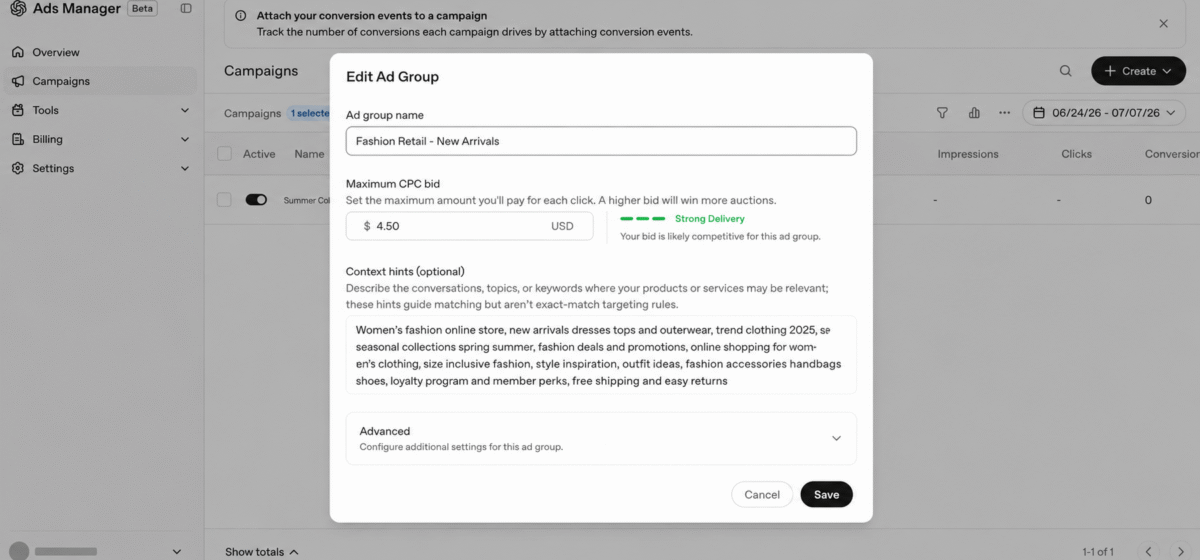
Context hints are submitted as a JSON array of short natural-language phrases at the ad group level, and they’re the single field that decides delivery. We treat this as a copywriting discipline, not a checkbox — more on that below. Retailers with a catalogue can connect a product feed instead, which we cover further down.
7. Upload creative and submit for review
Title, copy, image, destination URL, and UTMs all go in before review. If an ad comes back “not serving,” the fix is usually straightforward — but knowing which fix applies is where experience matters. We monitor and resubmit so nothing sits stalled.
How do you write context hints that actually deliver?
Context hints are short plain-language descriptions of the conversations where your ad belongs, and they work as interpretive guides rather than exact-match triggers. Get them too vague and you get no delivery; get them too narrow and you get delivery for the wrong reason.
This is exactly the kind of work we dominate at Deeploy and resolve for you: writing hints that describe what your ideal customer is actually typing, not what you sell. Someone doesn’t ask ChatGPT about “cloud-based invoicing solutions” — they ask whether they can stop paying for QuickBooks.
Specificity is the whole game. For an accounting product, a hint like small business accounting, tax preparation, invoicing workflow, and QuickBooks alternatives delivers. A single hint reading accounting is too broad to serve consistently against anything. We converge on five to ten tightly clustered hints per ad group, all circling one intent or persona — if your hints span two different buyer problems, that’s two ad groups, and we structure it that way from the start.
Here’s the part that changes how you budget: the winning ad is selected through a relevance-weighted second-price auction, so the most relevant ad wins rather than the highest bid. Creative quality and hint accuracy compete directly against spend — a competitor with triple your budget and lazy hints loses the placement.
That’s why ChatGPT advertising rewards teams who write well over teams who spend heavily, and it’s the single strongest argument for treating this channel as a copywriting exercise with a media budget attached — and for letting a team that already masters it handle the writing.
Running ecommerce? The product feed route skips most of this
Everything above assumes you are writing hints by hand. Retailers have a second option. In June 2026 OpenAI added a Feeds section to Ads Manager: connect a structured product catalogue and the platform generates ads automatically from product names, images, and attributes, instead of you building a unit per SKU.
The specifications that matter for planning: up to one million SKUs per advertiser, and new ecommerce partners submit a 100-product sample before connecting the full catalogue. OpenAI has said feed-based ads are among the strongest-performing formats in the beta so far, which is not surprising — a feed encodes product-level relevance that no hand-written hint can match.
This changed the retail calculus. Instant checkout, which let people buy inside the chat, was retired in March 2026 after conversion rates ran materially below click-out traffic. Feeds replaced it with something more conventional and, on the evidence so far, more effective: use the catalogue to earn the placement, then send the click to a page you control.
If you sell a service, none of this applies and context hints remain the only lever. If you sell products, connect the feed first and treat hand-written hints as the supplement rather than the foundation.
Reach or Clicks? Choosing the objective before you launch
Pick Clicks if you need measurable downstream conversions. Pick Reach if you are buying awareness against a defined audience and can absorb the volume required to read impact. Most advertisers testing the channel for the first time should start with Clicks, because it produces interpretable feedback inside the first week.
| Reach | Clicks | |
|---|---|---|
| Billing | CPM, cost per thousand impressions | CPC, cost per click |
| Bid field | Maximum CPM at ad group level | Maximum CPC at ad group level |
| Best for | Brand awareness, category entry, launch support | Lead generation, ecommerce, demand capture |
| Feedback speed | Slow, needs volume before impact reads | Fast, click behaviour visible within days |
| Risk profile | Pays for impressions regardless of engagement | Pays only on a click outcome |
| First test recommendation | Only with an existing awareness mandate | Default choice |
Whichever you choose, set it deliberately. The objective is locked at campaign level and dictates the bidding model underneath it.
How we optimize your ChatGPT Ads campaign from day one
From the first day your campaign runs, our team at Deeploy is already monitoring and analyzing the data — reading how your buyers are actually behaving, not just watching numbers accumulate. The first days are diagnostic by design: acting on incomplete data is exactly what removes the signal you need to optimize with, so instead of reacting to every early number, we let the campaign accumulate real delivery while we watch it closely.
Three checks matter early, and we run all three for you. First, we confirm ads are serving at all — if impressions sit near zero after 48 hours, the context hints are too narrow or too vague, and we rewrite them around your buyers’ actual phrasing. Second, we compare click-through rate across creative variants to find the one that pulls. Third, we check whether the traffic behaves like real intent by reading bounce rate, time on page, and conversion rate in your analytics.
We also watch the reporting lag before reacting. Dashboard numbers trail live delivery by hours, so a report reading zero at hour two means nothing at all — and pausing a campaign on that basis is the most common self-inflicted failure on the platform. We give delivery a full day to surface before we draw a conclusion from it.
By week two, we pause the ad groups and hints burning spend without conversions, shift budget to the one or two that deliver, and write a second creative round informed by what those first two weeks taught us.
Two structural pieces sit outside Ads Manager and decide whether any of this converts. Your conversion tracking setup determines whether you can trust the numbers, and your landing page conversion rate determines whether qualified clicks turn into revenue. Both are cheaper to fix before scaling spend than after — and both are things we review and fix as part of managing your account, not something we leave on your plate.
Where this gets expensive to learn alone
The setup takes an afternoon. Reading the results correctly takes experience with how relevance-weighted auctions behave, and the platform gives you almost no diagnostic feedback when hints underperform. Advertisers routinely spend a month discovering that their ad group structure was the problem.
Deeploy is a Digital Marketing Agency Toronto businesses hire for exactly that gap: a certified Google Premier Partner in the top 3% globally, managing more than $10 million in annual ad spend across 35 countries. We build the account, write the hints, implement the pixel and Conversions API, and report ChatGPT next to your Google, Meta, and Microsoft campaigns so you compare blended ROAS instead of guessing which channel earned the sale.
If you want a read on whether your category and creative can win a relevance-weighted auction before you fund the test, book a strategy call. We will tell you when the answer is no.
Frequently asked questions about advertising on ChatGPT
Do I need a minimum budget to advertise on ChatGPT?
No. The self-serve Ads Manager Beta removed the minimum spend entirely, down from a $250,000 commitment during the earliest pilot phase. Pilot advertisers bid $3 to $5 per click. Budget enough to reach interpretable data rather than a token amount that teaches you nothing.
Can I use my Google Ads keywords as context hints?
No, and copying them across is the most common setup error. Keywords describe what someone types into a search box. Context hints describe the conversation someone is having. Rewrite them as the problems, comparisons, and situations your buyer brings to an assistant.
How long does campaign review take before ads go live?
OpenAI reviews every campaign before it serves, and approval timelines vary while the platform remains in beta. If an approved ad shows a not serving status, hover the status in Ads Manager for the specific reason. Most causes are correctable and resubmittable the same day.
Which metrics does ChatGPT Ads Manager actually report?
Impressions, clicks, spend, click-through rate, average CPC, average CPM, and conversions, viewable in table form, performance charts, and CSV export. You can segment by device and country. Third-party measurement verification is not live yet, so reconcile against your CRM.
Can Canadian businesses advertise on ChatGPT?
Yes. Advertiser eligibility currently covers businesses based in the United States, Canada, Australia, and New Zealand. Ads serve to Free and Go tier users, since Plus, Pro, Team, Enterprise, and Edu subscriptions are ad-free.
The advertisers learning how to advertise on ChatGPT now are buying cheap tuition
Every field in this setup will change. The objectives will multiply, the creative formats will expand, and the auction will fill with competitors who currently think the channel is a novelty. What will not change is that relevance decides delivery, which means the advertisers who learn to write context hints while the auction is thin keep that advantage when it is not.
Run one campaign with the Clicks objective, five to ten tight hints per ad group, the pixel installed before launch, and thirty days of patience. That single test tells you more about whether your buyers live in ChatGPT than any forecast will.